


What is Black Death called today?
What do we call the Black Death disease today
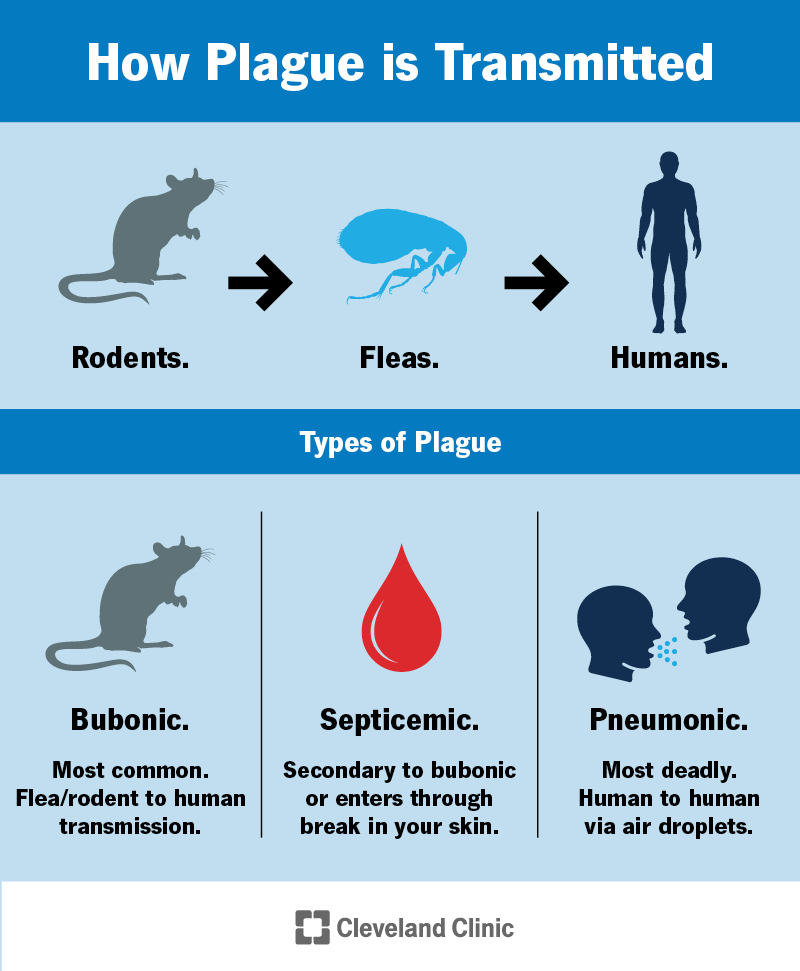
Plague is a disease that affects humans and other mammals. It is caused by the bacterium, Yersinia pestis. Humans usually get plague after being bitten by a rodent flea that is carrying the plague bacterium or by handling an animal infected with plague.
Cached
Does the Black Death exist today
Since that time, plague has occurred as scattered cases in rural areas. Most human cases in the United States occur in two regions: Northern New Mexico, northern Arizona, and southern Colorado. California, southern Oregon, and far western Nevada.
What are the 3 types of Black Death
Forms of plague.Bubonic plague: The incubation period of bubonic plague is usually 2 to 8 days.Septicemic plague: The incubation period of septicemic plague is poorly defined but likely occurs within days of exposure.Pneumonic plague: The incubation period of pneumonic plague is usually just 1 to 3 days.
Could the Black Death come back today
No. Bubonic plague killed at least one-third of the population of Europe between 1346 and 1353. But that was before we knew it was caused by the bacterium Yersina pestis. Bubonic plague does still occasionally occur in small flare-ups of a few dozen cases, but we have antibiotics to treat it now.
Are the bubonic plague and Black Death the same
The Black Death or bubonic plague killed more than 25 million people in fourteenth-century Europe. Yersinia pestis (the plague bacteria) can be easily weaponized as a bioterrorism agent.
Is the Black Death the second plague pandemic
The second plague pandemic was a major series of epidemics of plague that started with the Black Death, which reached Europe in 1348 and killed up to half of the population of Eurasia in the next four years. Although the plague died out in most places, it became endemic and recurred regularly.
Is COVID worse than the Black plague
That makes it worse in absolute terms than most influenza pandemics in history, except 1918's; worse than the seven cholera pandemics of the 19th and early 20th century; but much less bad than HIV, 1918, or the Black Death and associated bubonic plague outbreaks.
Where is the Black Death located today
The plague disease, caused by the bacterium Yersinia pestis, is enzootic (commonly present) in populations of fleas carried by ground rodents, including marmots, in various areas, including Central Asia, Kurdistan, Western Asia, North India, Uganda and the western United States.
What is the deadliest form type of plague
The total reported number of cases of all types of plague in 2013 was 783. Left untreated, pneumonic plague is always fatal. Some hypothesize that the pneumonic version of the plague was mainly responsible for the Black Death that resulted in approximately 75 – 200 million deaths in the 1300s.
Is there a difference between the Black Death and the bubonic plague
Victorian scientists dubbed it the Black … Death. As far as most people are concerned, the Black Death was bubonic plague, Yersinia pestis, a flea-borne bacterial disease of rodents that jumped to humans.
What stopped the Black Plague
The eventual weakening of the pandemic was likely due to the practice of quarantining infected people that originated in Venice in the 15th century and is with us to this day. Improved sanitation, personal hygiene, and medical practices also played a role in ultimately slowing the plague's terror march.
What happens if you survived the Black Death
In the study, Barreiro and his colleagues found that Black Death survivors in London and Denmark had an edge in their genes – mutations that helped protect against the plague pathogen, Yersinia pestis. Survivors passed those mutations onto their descendants, and many Europeans still carry those mutations today.
Was Ebola the Black Death
In virtually every textbook the Bubonic Plague, which is spread by flea-ridden rats, is named as the culprit behind the chaos. But mounting evidence suggests that an Ebola-like virus was the actual cause of the Black Death and the sporadic outbreaks that occurred in the following 300 years.
Was COVID worse than the Black Death
That makes it worse in absolute terms than most influenza pandemics in history, except 1918's; worse than the seven cholera pandemics of the 19th and early 20th century; but much less bad than HIV, 1918, or the Black Death and associated bubonic plague outbreaks.
What is the deadliest disease in history
1. The Black Death: Bubonic Plague. The Black Death ravaged most of Europe and the Mediterranean from 1346 until 1353. Over 50 million people died, more than 60% of Europe's entire population at the time.
What is the deadliest virus in history
1. The Black Death: Bubonic Plague. The Black Death ravaged most of Europe and the Mediterranean from 1346 until 1353.
What virus killed the most people
Cholera, bubonic plague, smallpox, and influenza are some of the most brutal killers in human history. And outbreaks of these diseases across international borders, are properly defined as pandemic, especially smallpox, which throughout history, has killed between 300-500 million people in its 12,000 year existence.
What was the worst plague in history
Black Death: 75-200M (1334-1353)
Is the Black Death still in Africa
Plague can be a very severe disease in people, with a case-fatality ratio of 30% to 60% for the bubonic type, and is always fatal for the pneumonic kind when left untreated. Currently, the three most endemic countries are the Democratic Republic of the Congo, Madagascar, and Peru.
What plague has no cure
Bubonic plague can be fatal if it's not treated. It can create infection throughout the body (septicemic plague) and / or infect your lungs (pneumonic plague.) Without treatment, septicemic plague and pneumonic plague are both fatal.
Is Ebola the Black plague
In virtually every textbook the Bubonic Plague, which is spread by flea-ridden rats, is named as the culprit behind the chaos. But mounting evidence suggests that an Ebola-like virus was the actual cause of the Black Death and the sporadic outbreaks that occurred in the following 300 years.
What is the most deadliest disease in history
1. The Black Death: Bubonic Plague. The Black Death ravaged most of Europe and the Mediterranean from 1346 until 1353. Over 50 million people died, more than 60% of Europe's entire population at the time.
What stopped the Black plague
The eventual weakening of the pandemic was likely due to the practice of quarantining infected people that originated in Venice in the 15th century and is with us to this day. Improved sanitation, personal hygiene, and medical practices also played a role in ultimately slowing the plague's terror march.
Why couldn t anyone stop the Black Death
The black death was extremely contagious, but at the time people didn't know how diseases spread, so they couldn't figure out how to stop it. The black death was a very deadly disease and almost nobody who got sick from it survived.
Was the Black Death anthrax
A: Most scholars think the Black Plague was a bacterial strain of Yersinia pestis. A growing minority of scholars (e.g., Graham Twigg) think we have misdiagnosed the disease, and that it was actually anthrax or some mutation of cattle murrain.